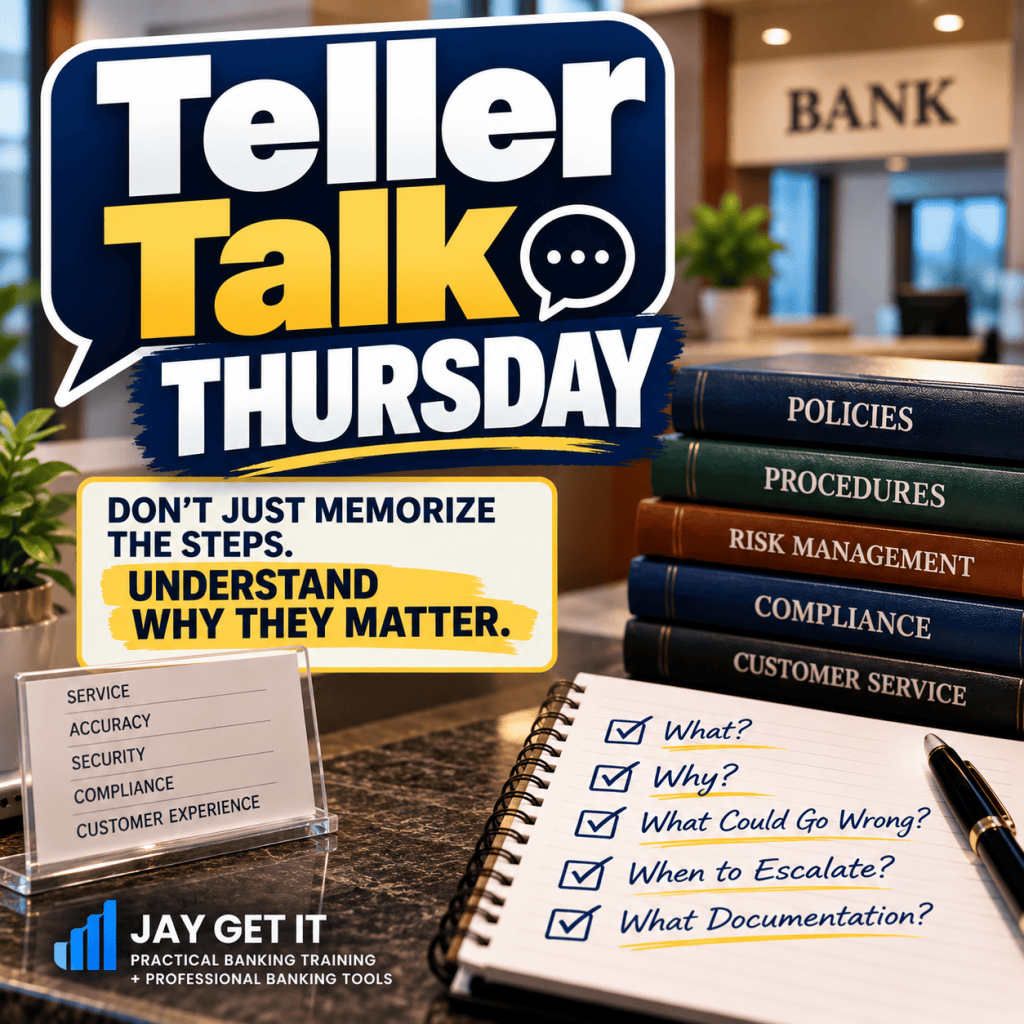
Bank teller training often begins with procedures.
How do you process this transaction? What steps do you follow? Which screen do you use? What documentation is required?
Learning those steps is important—but strong teller training should go further.
A teller who simply memorizes a procedure may know what to do when everything goes according to plan. A teller who understands why the procedure exists is better prepared to recognize when something doesn’t look right.
That distinction matters in banking.
For this Teller Talk Thursday, here are five questions tellers can use to move beyond memorization and build a stronger understanding of everyday banking procedures.
1. What Risk Is This Process Designed to Control?
Every procedure has a purpose.
When learning a transaction or operational process, ask:
What is this procedure trying to prevent, detect, document, or control?
Depending on the situation, the answer might involve:
- Transaction errors
- Fraud
- Unauthorized activity
- Customer identification
- Loss prevention
- Recordkeeping
- Regulatory requirements
- Internal controls
Understanding the risk behind a procedure gives the steps context.
Instead of thinking, “I have to do this because the procedure says so,” the teller begins to understand what the procedure is designed to accomplish.
That knowledge can make training more meaningful—and easier to remember.
2. What Could Go Wrong If a Step Is Missed?
Skipping a step may seem minor, especially during a busy day at the teller line.
But procedures often contain multiple controls for a reason.
During training, consider what could happen if an important step were skipped.
Could the transaction be processed incorrectly?
Could required information be missing?
Could an unauthorized transaction go undetected?
Could the bank lose money?
Could another employee reviewing the transaction later have difficulty determining what happened?
This doesn’t mean tellers should become afraid of making mistakes. It means training should connect each important step to its purpose.
When employees understand the potential consequence, the procedure becomes more than a checklist.
3. What Should Trigger an Escalation?
One of the most valuable skills a teller can develop is recognizing when to stop and ask for help.
Training should help tellers identify situations that fall outside normal processing.
Depending on the bank’s policies and procedures, examples might include:
- Information that doesn’t match
- Unusual customer behavior or transaction circumstances
- A transaction outside the teller’s authority
- Questions about identification or documentation
- A suspected error
- A system warning or alert
- A request the teller has not been trained to handle
- A situation that simply doesn’t look or feel consistent with normal processing
The goal isn’t for a teller to independently investigate or resolve every unusual situation.
The goal is to know when the situation should be referred to a supervisor, manager, or other appropriate resource according to the institution’s procedures.
Knowing when to escalate is part of knowing the job.
4. What Documentation Should Support the Decision?
Banking depends heavily on documentation.
When learning a procedure, tellers should understand not only what action to take but also what information or documentation is expected to support that action.
Ask:
If someone reviewed this transaction later, would the available documentation help them understand what occurred?
The specific documentation required will depend on the transaction, the institution’s policies, applicable requirements, and the teller’s authority.
The important training lesson is simple:
Don’t treat documentation as an afterthought.
It is often an important part of the process itself.
5. Could I Explain the Process Clearly to Someone Else?
Here’s a simple test for determining how well you understand a procedure:
Try explaining it.
Not just the individual steps.
Explain:
- What you’re doing
- Why you’re doing it
- What you’re checking
- What could require additional attention
- When you would stop and ask for assistance
If you can explain those points clearly, you probably have a much stronger understanding of the process.
If you can only repeat the steps from memory, there may still be a training gap.
From Memorization to Understanding
Tellers need procedures. Consistency and accuracy are essential parts of banking operations.
But effective teller training shouldn’t stop with:
Step 1 → Step 2 → Step 3 → Done.
Training should help employees understand the reasoning behind important procedures.
A stronger training conversation sounds more like this:
What are we doing?
Why are we doing it?
What risk are we controlling?
What should get my attention?
When should I stop and escalate?
What documentation is required?
Those questions help turn a procedure into practical knowledge that employees can apply on the teller line.
Your Teller Training Thursday Challenge
Choose one procedure you regularly perform and review it today.
Then answer these five questions:
- What risk is this process designed to control?
- What could go wrong if a step is missed?
- What should trigger escalation?
- What documentation should support the decision?
- Could I clearly explain the process to someone else?
If you can’t confidently answer one of them, you’ve identified your next training opportunity.
That’s what Teller Training Thursday is about: taking a few minutes each week to build stronger banking knowledge, one practical topic at a time.
Build Your Banking Knowledge with Jay Get It
Jay Get It provides practical banking training, professional banking tools, and financial education resourcesdesigned to help banking professionals strengthen their knowledge and apply it on the job.
Explore more teller training resources and professional banking tools at JayGetIt.com.
Training content is provided for general educational purposes. Financial institutions should follow their own policies and procedures, applicable laws and regulations, and guidance from appropriate legal, compliance, risk, and management personnel.

