
What Should a Bank Teller Say When They Don’t Know the Answer?
Every bank teller eventually gets a question they don’t know how to answer immediately.
It might be about a check hold.
A fee.
Account access.
A transaction you haven’t handled before.
A verification requirement.
Or a situation that simply doesn’t look familiar.
For newer tellers especially, that moment can be uncomfortable.
The customer is waiting.
There may be a line forming.
And it can feel like you’re supposed to know the answer right away.
You don’t.
What matters is what you do next.
A professional teller does not need to memorize every possible answer.
A professional teller needs to know how to pause, verify, and communicate clearly while finding the right answer.
The Biggest Mistake: Guessing
When you are unsure about a banking question, guessing is usually the wrong move.
Banking involves policies, procedures, customer information, transaction rules, security requirements, and institution-specific processes.
The correct answer may depend on details that are not obvious at first.
That is why one of the most useful teller habits is simple:
If you are not sure, verify before you answer.
Instead of saying:
“I think…”
or
“It should be…”
use language that gives you time to confirm the information.
For example:
“Let me verify that so I can give you the correct information.”
That phrase does three things at once.
It tells the customer you heard the question.
It explains why you are pausing.
And it shows that accuracy matters.
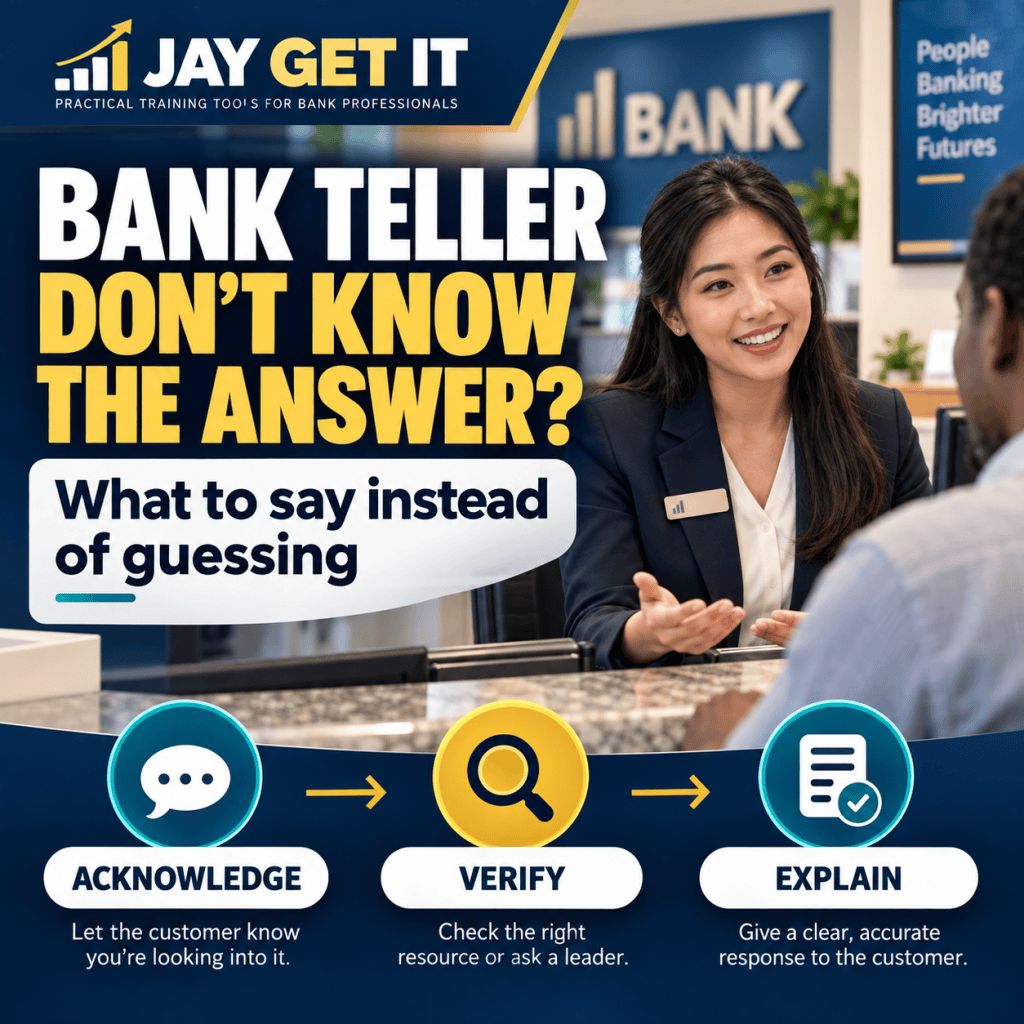
Use This 3-Step Approach
When a customer asks a question you cannot answer immediately, use this simple process:
1. Acknowledge the Question
Before you start searching for an answer, let the customer know you understand what they are asking.
You might say:
“I understand what you’re asking.”
or
“Let me make sure I understand correctly.”
Then restate the question if needed.
For example:
“Just so I understand correctly, you’re asking why this check isn’t available yet?”
This helps prevent you from researching the wrong problem.
2. Verify the Information
Now check the appropriate resource.
Depending on your institution, that might mean reviewing:
- internal procedures
- account information
- system notes
- transaction history
- approved reference materials
- supervisor guidance
- another department
Your financial institution’s current policies and procedures should always be the source of truth.
The goal is not to remember everything.
The goal is to know where to find the correct answer.
If you need additional time, tell the customer what you are doing.
Try:
“I’m going to take a moment to review this before we continue.”
or:
“Let me double-check the details so I can make sure I handle this correctly.”
That sounds much more professional than going silent while clicking through screens.
3. Return With a Clear Next Step
Once you have verified the information, explain it simply.
Avoid overloading the customer with internal terminology.
Focus on:
What is happening?
Why does it matter?
What happens next?
For example:
“I confirmed that one additional verification step is required before we can continue. Let me walk you through what we need.”
Or:
“I reviewed the account, and here’s what we’re able to do from here.”
Even when the answer is not what the customer hoped for, a clear next step helps keep the conversation productive.
What If the Customer Gets Impatient?
Sometimes customers do not like waiting while you verify information.
That pressure can make a new teller want to rush.
But rushing through an unfamiliar situation usually does not improve the interaction.
Instead, acknowledge the delay.
You might say:
“Thank you for your patience. I want to make sure I give you the correct information.”
This keeps the customer informed while reinforcing that you are working toward an accurate answer.
Professional communication does not mean pretending to know everything.
It means handling uncertainty calmly.
What If You Need to Ask Someone Else?
Ask.
There is nothing professional about guessing when someone else has the information you need.
If the situation requires assistance, you can say:
“Let me confirm this with the appropriate person so I can make sure we handle it correctly.”
If another employee or department needs to take over:
“Let me connect you with the right person who can help with the next step.”
That is better than:
“That’s not my department.”
The difference is small, but the customer experience is not.
One phrase ends the conversation.
The other moves it forward.
What New Tellers Should Focus On Instead of Memorizing Everything
When you are new, it can feel like experienced tellers simply know everything.
Usually, they do not.
They have seen more situations.
They recognize patterns faster.
They know where information is stored.
And they have developed language that helps them manage the customer conversation while they work.
Instead of trying to memorize every possible banking situation, build three things:
A reference system.
Know where your institution keeps important procedures and approved guidance.
A practice list.
Keep track of transactions and customer questions that still make you hesitate.
A professional communication toolkit.
Have a few reliable phrases ready for moments when you need to verify information, explain a requirement, or ask for help.
Those three things can make unfamiliar situations much easier to manage.
5 Professional Phrases for When You Need Time
Here are five phrases you can adapt:
1. “Let me verify that so I can give you the correct information.”
Use this when you need to confirm an answer.
2. “I’m going to take a moment to review this before we continue.”
Use this when you need time to check the system or procedure.
3. “Let me make sure I understand what you’re requesting.”
Use this when the customer’s explanation is unclear.
4. “Let me confirm the next step before I proceed.”
Use this when the transaction requires additional review.
5. “Let me connect you with the right person who can help with this.”
Use this when another employee or department needs to assist.
Don’t Say “I Don’t Know” and Stop There
There is nothing wrong with not knowing an answer.
The problem is ending the conversation there.
Compare these two responses:
“I don’t know.”
versus:
“Let me verify that so I can give you the correct information.”
Both communicate uncertainty.
Only one gives the customer confidence that you are working toward a solution.
That is the habit worth developing.
Build Your Teller Communication Toolkit
Knowing what to say is a skill.
That is why Jay Get It created the free 25 Bank Teller Customer Service Phrases Quick-Reference Guide.
It includes practical wording for common teller situations, including:
- clarifying customer needs
- buying time professionally
- explaining when the answer is no
- handling frustrated customers
- verification and security requirements
- closing customer interactions
- phrases to avoid and better alternatives
[Download the Free 25 Bank Teller Customer Service Phrases Guide]
Use it as a personal reference or training tool, and always adapt the wording to your financial institution’s current policies, procedures, and customer-service standards.
Teller Tuesday Check-In
Think back to when you were new.
What customer question used to make you nervous?
Was it:
- check holds?
- fees?
- transfers?
- large cash transactions?
- account access?
- verification?
- something else?
Leave a comment and tell us.
We use real teller questions and pain points to help decide what practical Jay Get It resources to build next.
Jay Get It
Practical banking training + professional banking tools + financial education.
For general training and educational purposes. Always follow your financial institution’s current policies, procedures, systems, and customer-service standards.

