
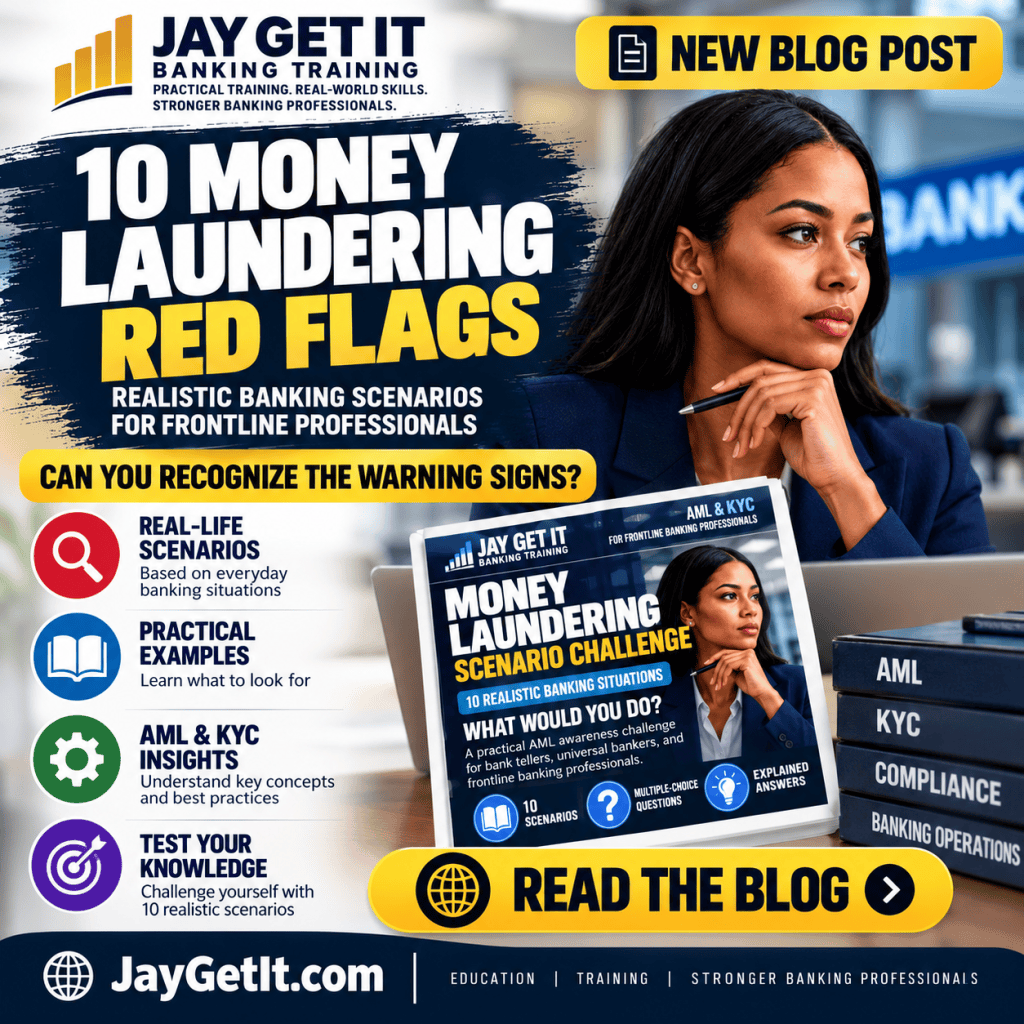
Could you recognize a potential money laundering red flag during an everyday banking transaction?
Imagine a customer who normally receives payroll deposits and pays routine bills. Suddenly, the account begins receiving unusually large cash deposits followed by multiple outgoing wire transfers.
Is this proof of money laundering?
No. But it may be a reason for additional review.
Recognizing the difference between unusual activity and confirmed wrongdoing is an important part of Anti-Money Laundering (AML) awareness.
For bank tellers, universal bankers, new accounts representatives, and other frontline banking professionals, the challenge is knowing what to notice, what questions to ask, and when to follow institutional escalation procedures.
In this Jay Get It banking training lesson, we’ll explore ten realistic situations that can help strengthen your AML and Know Your Customer (KYC) awareness.
You’ll also learn about our Money Laundering Scenario Challenge, a 10-question practice workbook with multiple-choice questions, explained answers, and a self-assessment.
What Is Anti-Money Laundering (AML) in Banking?
Anti-Money Laundering refers to the laws, regulations, programs, and controls designed to help prevent criminals from using the financial system to disguise proceeds from unlawful activity.
Banks and credit unions maintain AML compliance programs that include procedures for identifying customers, understanding relevant account activity, monitoring for potential concerns, and reporting certain activity when required.
Frontline employees play an important role because they interact directly with customers and may notice information that automated systems cannot fully explain.
However, a potential red flag does not prove that a customer has committed a crime.
The appropriate response depends on the available facts, the institution’s policies, and applicable legal and regulatory requirements.
What Is KYC, and Why Does It Matter?
Know Your Customer (KYC) refers broadly to practices financial institutions use to understand and verify relevant information about their customers.
Depending on the customer, account, and applicable requirements, this may include:
- Verifying required identifying information
- Understanding the nature and purpose of an account relationship
- Collecting relevant business ownership information
- Understanding expected account activity
- Updating customer information when appropriate
- Following customer due diligence and escalation procedures
KYC information helps banking professionals evaluate transactions in context.
For example, a restaurant that regularly handles cash may have a very different expected activity pattern from an employee who primarily receives payroll deposits.
The important question is not simply whether cash or electronic transfers are involved.
It’s whether the activity makes sense in light of what the institution knows about the customer.
10 AML Awareness Situations Every Banking Professional Should Understand
The following examples are based on the fictional scenarios in Jay Get It’s Money Laundering Scenario Challengeworkbook.
1. A Customer’s Transaction Pattern Changes
A customer historically receives regular payroll deposits and makes predictable bill payments.
Recently, the account shows substantially larger cash deposits followed by outgoing wire transfers to multiple accounts.
What should you recognize?
A significant change from established account activity may warrant additional review.
Do not assume that sufficient account funds mean there is no concern. Likewise, do not assume the customer is involved in money laundering.
Training takeaway: Compare activity with the customer’s known profile and follow approved review and escalation procedures.
2. A Customer Requests a $25,000 Cash Withdrawal
A bank teller receives a request for a $25,000 cash withdrawal. The customer explains that the funds are needed for a real estate transaction.
Does a large withdrawal automatically mean criminal activity?
No.
Large cash transactions can be legitimate. The teller must follow applicable identification, cash-handling, reporting, and institutional procedures.
The workbook uses this scenario to reinforce an important distinction: a qualifying currency transaction may require reporting, but reporting alone does not establish suspicious activity.
Training takeaway: Apply the required procedures without treating the transaction amount as proof of wrongdoing.
3. Money Moves Rapidly Through an Account
An account repeatedly receives funds that are transferred out shortly afterward.
This activity differs from the customer’s previously established account behavior.
What matters most?
The pattern, timing, available customer information, and relevant context.
Electronic transfers are not inherently illegal. But unusual movement of funds may warrant review.
Training takeaway: Evaluate the activity in context rather than automatically labeling all transfers suspicious.
4. A Customer Asks How to Avoid Reporting Requirements
A customer asks whether a large cash transaction will be reported.
After receiving an explanation of applicable procedures, the customer suggests splitting the transaction into smaller amounts specifically to avoid reporting.
This raises a potential structuring concern.
A frontline employee should not recommend transaction splitting to avoid reporting requirements.
Training takeaway: Follow institutional procedures and refer potential structuring concerns through approved channels.
5. A Cash-Intensive Business Changes Its Deposit Activity
A restaurant regularly deposits cash.
Recently, the amount deposited increases substantially compared with the business’s historical activity and what the institution knows about its operations.
Does this automatically mean the restaurant is laundering money?
No.
There may be legitimate business explanations for changing deposit activity.
The employee should consider the available customer information, expected activity, and institutional review procedures.
Training takeaway: Cash-intensive businesses should be evaluated fairly and in context.
6. A Customer Gives Inconsistent Wire Transfer Information
A customer requests an international wire transfer.
When asked for information required by the institution, the customer provides inconsistent explanations about the recipient and transaction purpose.
What should the banker do?
Follow applicable verification and wire-transfer procedures, document relevant facts, and escalate concerns when required.
Do not bypass required information simply to complete the transaction.
Training takeaway: Accurate information and consistent procedures are essential in payment operations.
7. A New Business Customer Cannot Provide Required Information
A customer wants to open a business account but cannot provide required information about ownership and expected account activity.
The customer becomes frustrated when the banker explains the documentation requirements.
Customer frustration alone is not proof of fraud.
However, required account-opening and customer due diligence procedures should not be skipped.
Training takeaway: Collect required information and follow approved verification and escalation procedures.
8. A Longtime Customer Makes a High-Value Purchase
A longtime customer requests a large cashier’s check to purchase a vehicle.
The transaction appears consistent with available customer information, and no additional unusual circumstances have been identified.
Should the teller automatically consider the transaction suspicious?
No.
An expensive purchase is not inherently evidence of money laundering.
The teller should follow applicable transaction procedures and consider the surrounding circumstances.
Training takeaway: High transaction values require appropriate handling, not automatic accusations.
9. A Referred Customer Is Reluctant to Explain the Source of Funds
An existing customer refers someone to the bank.
The new customer wants to open multiple accounts and immediately transfer significant funds from another institution but is reluctant to provide required information about the source of those funds.
Does the referral remove the need for due diligence?
No.
A referral does not replace customer verification or account-opening requirements.
Training takeaway: Obtain required information and escalate concerns when appropriate.
10. A Customer Asks Whether the Bank Filed a SAR
A customer becomes upset and asks whether the bank filed a Suspicious Activity Report (SAR) about their account.
This situation involves an important confidentiality requirement.
Bank employees must not disclose whether a SAR exists or has been filed.
Follow approved communication and escalation procedures, and refer the inquiry to designated personnel when appropriate.
Training takeaway: Protect SAR confidentiality and never confirm or deny the existence of a SAR to a customer.
The Four Everyday Habits of AML-Aware Banking Professionals
Recognizing potential red flags becomes easier when employees consistently practice four habits.
1. Be Observant
Pay attention to unusual or inconsistent activity.
Consider the customer’s profile, business type, and expected account behavior.
2. Follow Procedures
Use your institution’s approved policies, systems, resources, and documentation requirements.
Do not substitute assumptions for established controls.
3. Ask Appropriate Questions
When required, ask clear and professional questions to understand the purpose of a transaction or obtain necessary customer information.
Avoid accusatory language.
4. Speak Up
Report relevant concerns through approved internal channels.
Document factual observations and escalate when required.
Remember: Your role is to recognize and appropriately report concerns—not to independently determine whether a customer has committed a crime.
Test Your AML Knowledge: A Quick Banking Scenario
Here’s a practice question.
Scenario:
A customer who usually receives payroll deposits begins receiving larger cash deposits followed by several outgoing wire transfers.
What is the best response?
A. Ignore the activity because the account has sufficient funds.
B. Recognize that the change may warrant further review.
C. Conclude that the customer is definitely laundering money.
D. Assume all wire transfers are suspicious.
Correct Answer: B
A significant change in transaction activity may warrant further review.
The pattern is a potential indicator, not proof of criminal conduct.
The appropriate response is to consider available customer information and follow institutional review and escalation procedures.
Take the Jay Get It Money Laundering Scenario Challenge
Reading about AML red flags is helpful.
Practicing how you would respond is even better.
Jay Get It’s Money Laundering Scenario Challenge is a practical training workbook designed for frontline banking professionals.
What’s Included?
- 10 fictional banking scenarios based on common frontline situations
- Multiple-choice questions with four possible responses
- Explained answers to help you understand the reasoning
- AML and KYC awareness practice
- A scoring guide to help identify areas for further learning
- Four everyday habits to reinforce better banking practices
The challenge covers bank tellers, universal bankers, branch employees, and new accounts representatives.
It can be used for individual study, training discussions, or general professional development.
How the Challenge Works
- Read each fictional banking scenario.
- Choose the single best response: A, B, C, or D.
- Record your answers before reviewing the answer key.
- Read the explanations to understand the key lessons.
- Calculate your score out of ten and identify topics to review.
The scoring guide is intended for informal learning and self-assessment. It does not provide regulatory certification or establish professional competency.
Ready to test your judgment?
Explore Jay Get It’s banking training resources and look for the Money Laundering Scenario Challenge.
Visit: https://jaygetit.com
You can also explore additional free banking resources at:
https://jaygetit.com/free-resources
Frequently Asked Questions About AML Training
What are common money laundering red flags in banking?
Potential indicators may include activity inconsistent with a customer’s established profile, unusual transaction patterns, unexplained changes in cash deposits, inconsistent transaction explanations, or attempts to avoid reporting requirements. These indicators must be evaluated in context.
Do bank tellers need AML training?
Bank tellers may have responsibilities under their institution’s AML compliance program. Their specific training requirements and procedures depend on the institution and applicable rules.
Is a large cash withdrawal automatically suspicious?
No. Large cash withdrawals can be legitimate. Employees must follow applicable cash-handling, identification, reporting, and review procedures.
What is the difference between AML and KYC?
AML broadly concerns preventing and detecting misuse of the financial system for money laundering and related financial crimes. KYC focuses on understanding and verifying relevant customer information and is an important part of financial institutions’ risk-management and compliance practices.
Can a bank employee tell a customer that a SAR was filed?
No. SAR confidentiality requirements generally prohibit disclosing the existence of a SAR to the customer involved. Employees should follow approved institutional communication and escalation procedures.
Is the Jay Get It challenge an official AML certification?
No. It is an educational practice resource designed to reinforce AML awareness and decision-making. It does not replace required institutional training, legal guidance, or regulatory certification.
Final Takeaway: Recognize. Analyze. Respond.
Strong AML awareness begins with good judgment.
Not every unusual transaction is criminal.
Not every large transaction is suspicious.
And not every red flag requires the same response.
Banking professionals should understand the available information, follow approved procedures, document relevant facts, and escalate concerns when appropriate.
Recognize potential indicators. Analyze the context. Respond according to your institution’s procedures.
Keep building your knowledge with Jay Get It.
Know It. Apply It. Get It.
Educational disclaimer: This article and the associated workbook provide general AML and KYC awareness education using fictional scenarios. They are not legal advice, regulatory certification, or a substitute for an institution’s current Bank Secrecy Act/AML program, policies, training, or compliance guidance. Employees should follow applicable laws and their institution’s approved procedures.

