
Published November 10, 2026 | Jay Get It Banking Education
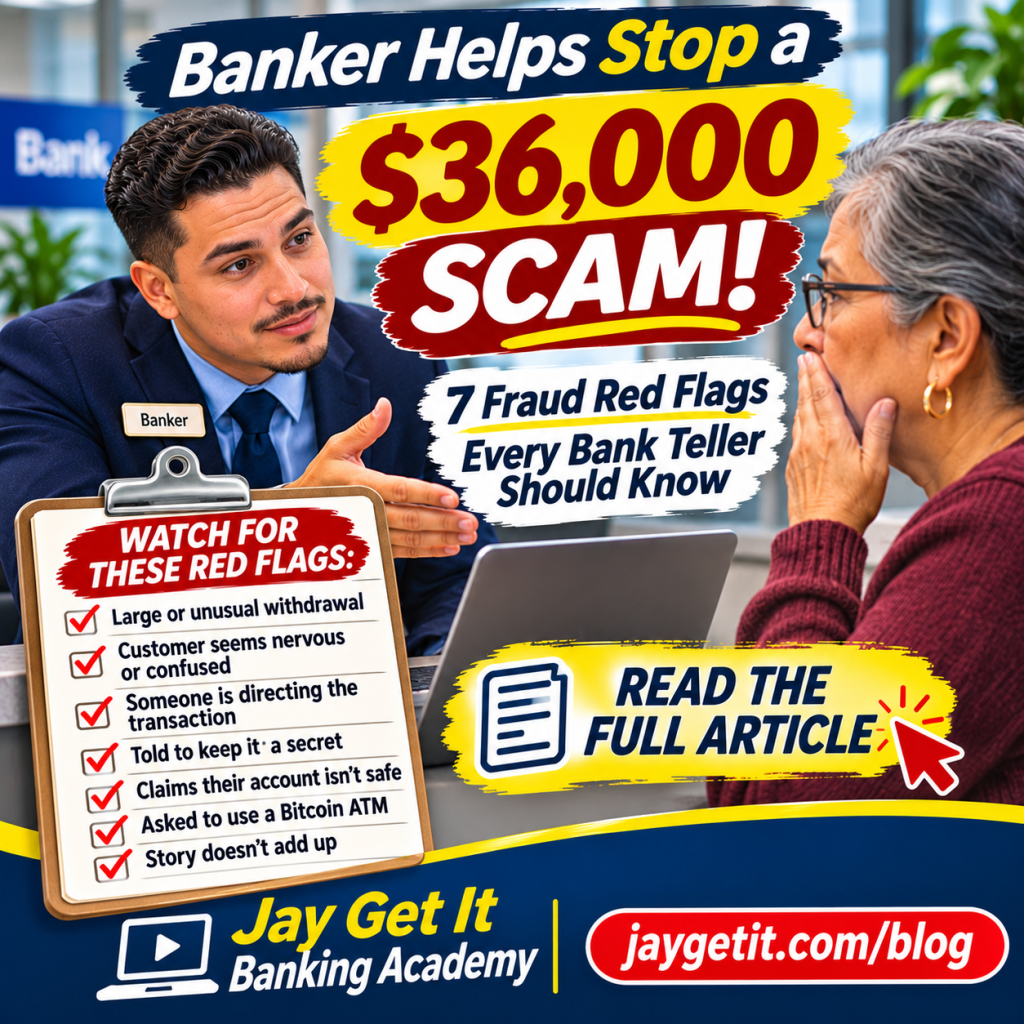
What if one conversation at the teller window could prevent someone from losing $36,000?
That’s exactly the kind of difference a banking professional can make.
A recent story out of Michigan highlights how one banker recognized potential financial exploitation and helped protect a customer from a sophisticated scam.
For anyone working as a bank teller, personal banker, or branch manager, this story offers an important lesson:
Sometimes the most important transaction is the one you stop to investigate.
A Real Banking Scam: What Happened?
According to a November 8, 2026, report from the Pioneer, Fifth Third Bank manager Kimber Etchison helped protect a customer from a scheme involving fake technical support representatives, bank impersonators, and a cryptocurrency ATM.
The customer, identified as Diane, had received a fraudulent computer warning that led her to contact someone claiming to provide technical support.
The scammers convinced her that her financial accounts were compromised.
They instructed her to withdraw money, conceal the situation from family members, and provide misleading explanations to bank employees.
She had already withdrawn $16,000 from another financial institution and arrived at Fifth Third Bank seeking another $20,000.
But the banker noticed something unusual.
The customer appeared uncertain about the transaction and was requesting an unusually large withdrawal at a branch she did not normally use.
Instead of ignoring these warning signs, the banker asked questions and worked to understand what was happening.
The intervention helped prevent the planned $36,000 loss.
Read the original report: Big Rapids banker stops $36,000 scam targeting customer.
Why This Story Matters for Bank Employees
Banking employees process countless legitimate transactions every day.
Customers withdraw cash, transfer money, purchase cashier’s checks, and move funds between accounts.
Most of these transactions are perfectly normal.
However, criminals sometimes manipulate legitimate customers into conducting transactions that benefit the criminals.
That means the person standing in front of the teller may be the victim rather than the person committing fraud.
Recognizing this distinction is essential.
A suspicious transaction does not automatically mean a suspicious customer.
7 Fraud Red Flags Every Bank Teller Should Recognize
1. An Unusual Cash Withdrawal
A customer suddenly requests a large withdrawal that differs significantly from their normal banking activity.
A large withdrawal alone does not establish fraud. But it may justify additional questions based on the customer’s account history, circumstances, and institutional procedures.
2. The Customer Appears Nervous or Confused
The customer seems anxious, has trouble explaining the transaction, or appears uncertain about what to do next.
Bankers should avoid making assumptions based solely on someone’s behavior.
Instead, look at the entire situation and use respectful questions to identify possible concerns.
3. Someone Else Is Directing the Transaction
A customer mentions that another person told them to withdraw money immediately.
The person may be communicating through a telephone call, text message, or messaging application.
This becomes especially concerning when the customer is being coached on what to say.
4. The Customer Has Been Told to Keep a Secret
Scammers frequently discourage victims from discussing transactions with family members, trusted contacts, or bank employees.
They may claim the situation involves a confidential investigation or an urgent security matter.
Secrecy combined with pressure should raise concern.
5. The Customer Is Told Their Money Is Not Safe
A common scam involves someone impersonating a bank employee, government official, or technical support representative.
The impersonator may claim that the customer’s bank account has been hacked and that funds must be moved immediately.
A legitimate bank or government agency will not instruct a customer to deposit cash into a cryptocurrency ATM to protect their money.
6. The Customer Is Directed to a Bitcoin ATM
Cryptocurrency ATMs allow consumers to purchase digital assets, but scammers exploit these machines to move stolen funds.
According to the California Department of Financial Protection and Innovation, criminals may instruct victims to withdraw cash, visit a crypto ATM, and scan a QR code connected to a scammer-controlled wallet.
Once funds are transferred, recovering them can be extremely difficult.
7. The Customer’s Explanation Doesn’t Match the Circumstances
A customer says the cash is for home repairs but later mentions someone from a fraud department telling them to withdraw it.
Inconsistencies can occur for innocent reasons, so they should not be treated as proof of wrongdoing.
However, they may indicate that a customer is being manipulated or coached.
The appropriate response is to ask clarifying questions and follow your institution’s escalation procedures.
What Should a Bank Teller Do When Something Doesn’t Feel Right?
Consider this realistic training scenario.
A customer requests a $12,000 withdrawal.
They appear nervous and repeatedly check their phone.
When asked about the purpose of the transaction, they respond:
“Someone from the fraud department told me to withdraw it today because my account isn’t safe.”
What should you do?
A. Process the transaction immediately because the customer owns the money.
B. Accuse the customer of participating in fraud.
C. Ask respectful questions, identify potential warning signs, and follow your institution’s fraud escalation procedures.
D. Ignore the warning signs and complete the transaction.
The best answer is C.
The goal is not to interrogate or embarrass the customer.
The goal is to understand the situation, provide accurate information, and follow procedures designed to protect customers and the institution.
Any decision to delay or refuse a transaction must comply with applicable laws and institutional policies.
Five Practical Steps for Bank Employees
When potential financial exploitation is identified:
- Recognize: Look for unusual transactions, outside instructions, urgency, secrecy, and other warning signs.
- Ask: Use neutral, open-ended questions that allow the customer to explain the situation.
- Listen: Pay attention to statements that suggest someone else is controlling or directing the transaction.
- Escalate: Contact the appropriate supervisor, fraud department, or designated team according to institutional procedures.
- Document: Record relevant facts accurately and follow required reporting and confidentiality procedures.
Bank employees should never promise that a transaction will be stopped or that lost money can be recovered.
Turn Fraud Awareness Into Practical Banking Skills
Reading about fraud is helpful.
But recognizing suspicious behavior during a live transaction requires practice.
Bank tellers and personal bankers benefit from training that connects warning signs to realistic decisions.
For example, how would you respond if a customer:
- Refused to answer questions about an unusually large withdrawal?
- Said they were instructed to send cash to a cryptocurrency machine?
- Claimed a bank employee told them to keep a transaction secret?
- Appeared to be receiving instructions from someone on the phone?
These situations require good judgment, professionalism, and knowledge of the institution’s procedures.
Strengthen Your Skills With Jay Get It Banking Academy
At Jay Get It, our goal is to make banking education practical, understandable, and relevant to real-world situations.
Whether you’re preparing for your first bank teller position, developing your personal banker skills, or strengthening your banking knowledge, learning how to recognize potential financial exploitation is an important part of professional development.
Explore Jay Get It Banking Academy:
Build your knowledge. Strengthen your judgment. Become a more confident banking professional.
Final Takeaway: One Question Can Make a Difference
The recent Michigan case demonstrates why banking employees play an important role in fraud prevention.
The banker did more than process a transaction.
She recognized warning signs, asked questions, and helped a customer understand what was happening.
Not every unusual withdrawal is fraud, and not every warning sign indicates financial exploitation.
But when employees are trained to recognize patterns and respond appropriately, they are better prepared to protect the people they serve.
The next time something doesn’t add up at the teller window, remember: asking the right question may be the most valuable part of the transaction.
Join the Conversation
Bank tellers and personal bankers: What’s the biggest fraud red flag you’ve encountered while helping a customer?
Share your experience in the comments without including confidential customer information.
Sources and Further Reading
- Pioneer — Big Rapids banker stops $36,000 scam (November 8, 2026)
- California DFPI — Crypto ATM Scam Prevention
- FTC — Did Someone Send You to a Bitcoin ATM?
Educational disclaimer: This article provides general banking education and is not a substitute for your financial institution’s policies, compliance requirements, or legal guidance.

